
26%
After Max-Emitter Conversion, 7 New Monthly Production Records Set — Gold Extraction Increases 26%
Gold Mining
Read Full StoryCase Study

Results
About this resource
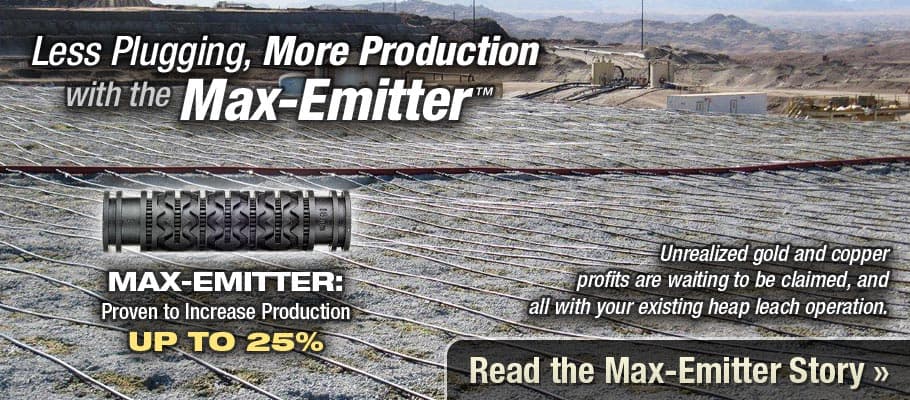
After successfully using Ore-Max drip emitters for years, the mine purchasing department decided to "save money" by purchasing less expensive agricultural emitters. Immediately after the conversion, copper extraction on the heap dropped from the mid-80's to the low 70's — approximately 13-percentage points or 18%. The first explanation given was that the ore had changed and 80% extraction was no longer possible.
After operating for more than one year with poor leach results — and a tankhouse that was not at 100% capacity — management decided to test six different types of drip emitters, including the Max-Emitter. Each of the six types of emitters were put on a complete cell and the differences were immediately evident in the flow uniformity across each cell.
The metallurgical crew set up an elaborate sampling system across each test cell. They reported that the Max-Emitter had the most consistent solution distribution, with less than ±0.5 liters per hour per square meter variation in flow. Surprisingly, the next closest emitter tested had ±2.0 liters per hour per square meter variation in flow.
Based on the improved solution distribution, the mine decided on the Ore-Max Max-Emitter. After conversion, copper extraction went to the mid to upper 80's — more than an 18% increase in copper extraction — and the electrowinning tankhouse was at 100% capacity for the first time in years.
Related
More from the Ore-Max library — hand-picked to match what you're reading.
26%
Gold Mining
Read Full Story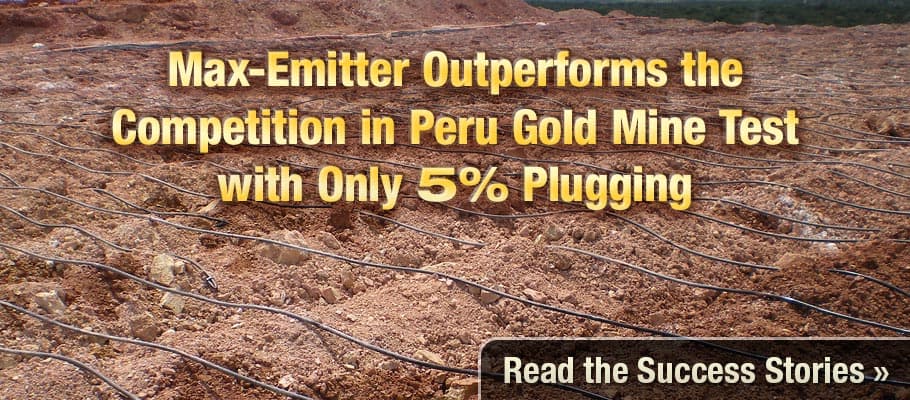
10%
Gold Mining
Read Full Story
25%
Copper Mining
Read Full Story