
26%
After Max-Emitter Conversion, 7 New Monthly Production Records Set — Gold Extraction Increases 26%
Gold Mining
Read Full StoryCase Study
Results
About this resource
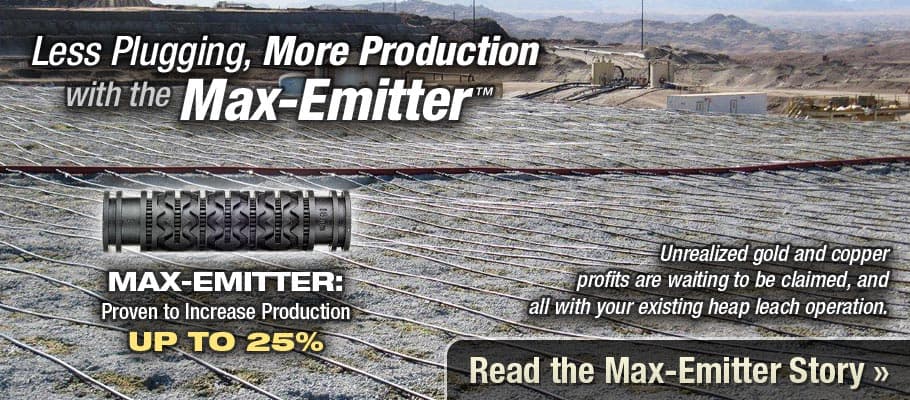
A copper operation in the U.S. was still using a sprinkler system for heap leaching — but management wanted to investigate the use of drip emitters to see if there was any difference between the two methods of leaching. A considerable amount of planning and effort went into the test preparation. First, a drainage system was constructed under the two identical leach areas that would be used in the test. The drainage systems would be used to take PLS (pregnant leach solution) samples every 8-hours throughout the test. Second, the mine was instructed to alternate trucks to the two leach areas to have as homogenous an ore blend as possible. Third, the test was conducted using the same application rate, so the Max-Emitter flow rate and spacing on the tubing and on the header was designed to match the application rate with the sprinkler system.
Once the ore was dumped and the two leach systems installed and started, solution began reporting on the sprinkler area after only one day. The Max-Emitter drip emitter area took 5-days for solution to report. PLS grade on the sprinkler area was lower than on the Max-Emitter area at solution breakthrough and actually for the entire test.
Why this difference with identical leach solution application rates? Investigating this test and previous tests comparing sprinklers and drip emitters has shown that sprinkler systems tend to channel through the leach area and not wet all of the ore. With the drip emitters, capillary action pulls the solution into all the ore and voids and crevices before gravity pulls it to the bottom of the leach area. By wetting all of the ore with the Max-Emitter, more copper is leached from the ore and higher extractions are experienced.
In this test, the sprinkler area recovered approximately 60% of the total copper in the heap (70% of the acid and cyanide soluble copper) and the Max-Emitter recovered approximately 80% of the total copper in the heap (90% of the acid and cyanide soluble copper), a 25% increase in total copper extraction. Management could not believe the results — so a second test was conducted — with almost identical results, although the copper extraction difference was even higher than in the first test.
An additional benefit of the Max-Emitter system over a sprinkler system is reduced evaporation losses. In arid regions of the U.S. or South America, the Max-Emitter system can reduce evaporation losses by almost 50%, reducing fresh water makeup to the leach system by the same amount. Water savings at many operations is critical because at some mines in South America, the most expensive reagent at the mine is fresh water.
Related
More from the Ore-Max library — hand-picked to match what you're reading.
26%
Gold Mining
Read Full Story
18%
Copper Mining
Read Full Story
10%
Gold Mining
Read Full Story